Talk to any first-time exhibitor and you’ll hear the same question: “How do I know if my puppy is doing well in the ring?” The answer is hiding in plain sight inside the AKC Puppy of Achievement Points system. Ten tiny points — each one earned in a beginner-friendly conformation class — turn an ordinary show weekend into a crystal-clear progress bar. No majors, no complicated math, just a simple tally that says, “Yes, your pup is on track.”
The program’s magic is its speed. A six-month-old puppy can walk into a 4-6 Month Beginner Puppy (BPUP) ring on Saturday morning, wag through two quick laps, and leave the fairgrounds that afternoon with a ribbon worth one, two, or even three AKC Puppy of Achievement Points. Add those numbers together until you reach ten, and the American Kennel Club mails a handsome certificate plus the “POA” suffix for life.
Yet the point chart alone isn’t enough. New handlers juggle entry deadlines, class sizes, hotel bills, and growth-spurt timing. That’s why we made a free Puppy of Achievement Points Tracker PDF — a one-page sheet you can print and mark after every class win. In this guide, you’ll learn exactly how the point values work, how to plan a winning show calendar, and how to use the tracker to stay motivated from your very first win to that tenth and final point.
Understanding AKC Puppy of Achievement Points
The AKC Puppy of Achievement Points program is a bridge between raw enthusiasm and serious show goals. Puppies under twelve months compete in BPUP or regular 6-9 Month and 9-12 Month classes. Each class win adds points to the puppy’s record automatically — no extra entry fee, no special form. Collect ten points before the first birthday, and the pup earns the Puppy of Achievement certificate. The system does three big things:
Keeps beginners engaged. Ten points are easy to visualize and fast to reach, so new handlers feel progress almost immediately.
Builds ring confidence. Puppies learn the sights and sounds of shows without marathon wait times.
Provides early feedback for breeders. Judges’ comments and class placements reveal structure and movement strengths long before adult titles are on the horizon.
Unlike Championship points, AKC Puppy of Achievement Points never require majors. A single puppy in the class can still earn a valuable point, and three-dog classes can award two points — perfect for smaller shows where entries run lean.
Point System Breakdown — How Many Points per Class Win?
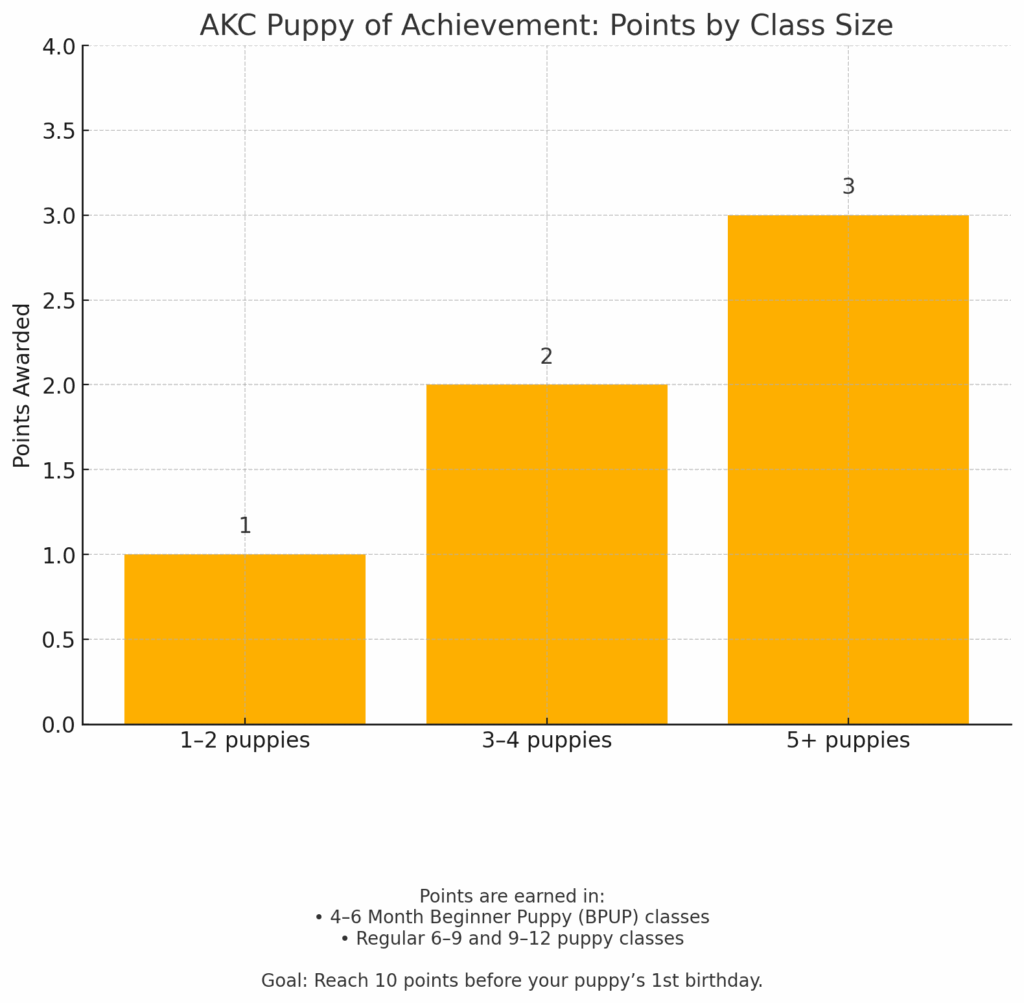
The entire system rests on one tidy table:
1–2 puppies in class → 1 point
3–4 puppies in class → 2 points
5 + puppies in class → 3 points
That’s it. No hidden multipliers, no regional adjustments. The American Kennel Club defined it this way so every beginner could do the math in their head before the judge hands out ribbons.
Where points come from
4-6 Month Beginner Puppy (BPUP). Best of Breed (BOB) and Best of Opposite Sex (BOS) earn the point value tied to that breed’s entry size. If your puppy advances to Group or Best in Show, the highest point value earned by any breed that day applies again—handy for rare breeds that might stand alone in the breed ring.
Regular puppy classes (6-9, 9-12). A class win triggers the same table above. Male and female classes score separately, so you can collect points in both sex divisions on the same day if you travel with two puppies of different sexes.
The moment the judge points to your dog, those AKC Puppy of Achievement Points land in the AKC database—usually within a week of the superintendent posting results.
Free Puppy of Achievement Points Tracker PDF
A point here, two points there—after three busy weekends it’s easy to forget exactly how close you are to ten. That’s where the free Tracker PDF comes in. Print one sheet per puppy, slide it into a plastic sleeve, and stash a dry-erase marker in your tack box. The tracker helps in four ways:
Visual motivation. Filling a square with bright ink feels just as good as hanging a ribbon on the kennel door.
Show history at a glance. Date, location, event type, entry size—handy details if you need to verify results with AKC event records later.
Goal prediction. Spot patterns in entry sizes and schedule your next show where class counts will likely give you two- or three-point wins.

👉 Grab your copy here:
Planning Your Show Calendar Around AKC Puppy of Achievement Points
A smart schedule can shave months off the journey to ten points. Here’s a practical approach:
A. Map your driving radius. Within three hours, list every kennel club hosting BPUP or all-breed shows. Smaller clubs in rural areas may offer lighter competition, while metropolitan clusters often draw five-puppy classes worth three points.
B. Check last year’s catalogs. Many clubs post entry numbers on Facebook or their websites. Knowing a venue’s typical puppy count lets you predict point values in advance.
C. Cluster efficiency. Four shows in one Thursday–Sunday cluster equal four chances to collect AKC Puppy of Achievement Points while paying only one round of travel costs.
D. Growth-spurt timing. Schedule shows during “cute weeks.” Puppies can look awkward right after a growth burst; give them a fortnight to rebalance before stepping under fluorescent lights.
E. Climate control. Outdoor summer shows risk midday heat. A hot ring can sap energy and ruin movement. Early-morning BPUP groups or air-conditioned indoor venues protect little paws and preserve top gait.
Three Expanded Paths to Ten Points
Path 1: The Big-Entry Sprint
Hit a major spring cluster where the average puppy class breaks the five-entry mark. One three-point BPUP Best of Breed plus two three-point wins in the 6-9 class rockets you to nine points. A single two-point win the next morning seals the deal. You’re done in 48 hours, certificate en route.
Path 2: The Steady Glide
Local one-day shows often pull three- to four-dog classes. Win one class a month for five months, and you’re sitting on ten AKC Puppy of Achievement Points well before the first birthday. The steady rhythm keeps your puppy socialized without overloading weekends.
Path 3: Rural Strategy + Urban Boost
Small rural shows with one- or two-dog classes help nervous puppies find their footing. Rack up five single-point wins early. Once confidence is high, drive to a city show with bigger entries and score a three-point BPUP BOS and a two-point 9-12 class. Total: ten points, balanced experience, and a pup that trusts the ring.
Track, Win, Celebrate
The road to that shiny Puppy of Achievement certificate is paved with exactly ten AKC Puppy of Achievement Points, nothing more. With the point chart burned into your brain, a smart show calendar taped to your fridge, and a freshly printed Puppy of Achievement Points Tracker PDF, you now have every tool you need. Whether you aim to blast through three-point wins in one epic weekend or stroll the steady path of monthly shows, each checkmark on the tracker inches you closer to that first, pride-filled title.
Remember, the lessons you and your puppy learn today — ring manners, handler focus, fearless movement — will echo in every future class, from Open to Best of Breed to the Grand Champion lineup. So circle your next show date, load the crate, and head for the fairgrounds. Your puppy’s tenth point — and a lifetime of show-ring confidence — are waiting just beyond that steward’s table.
Frequently Asked Questions
Are AKC Puppy of Achievement Points the same as Championship points?
No. Championship points follow a completely different schedule that requires majors and a total of fifteen points. POA points are an independent, entry-level metric.
Do POA points expire?
Only when your pup turns one year old. After that date, the system stops counting toward POA, but your existing points remain valid forever.
Does earning POA help in Junior Showmanship?
While POA points don’t transfer, the ring experience does. Judges love seeing juniors handle puppies that already move and stack confidently.